


How Long Do Electric Truck Batteries Last? How to Extend Battery Life
How Long Does an Electric Truck Battery Last?
Electric truck battery lifespan is generally evaluated based on two criteria: service life (in years) and the number of charge-discharge cycles. Modern lithium-ion batteries, particularly Lithium Iron Phosphate (LFP) batteries, can last approximately 8–15 years under suitable operating conditions. In terms of charging cycles, many LFP battery systems have a designed lifespan of around 2,000–5,000 cycles or more, depending on the configuration and evaluation standards.
One charge-discharge cycle is equivalent to using a total of 100% of the battery’s capacity. For example, if a truck consumes 50% of its battery capacity and then recharges, before consuming another 50%, the total usage is equivalent to one full cycle.
It is important to note that these figures are for reference only and do not represent a guaranteed lifespan for every electric truck model.
How Long Does It Take for Electric Truck Batteries to Degrade?
Electric truck batteries gradually age over time and with use, but the rate of capacity degradation is generally slow. Battery degradation is assessed using the State of Health (SOH) indicator, which reflects the battery’s current condition compared to its original capacity.
For example, if an electric truck can travel 250 km on a single charge under specific conditions, its theoretical driving range may change according to the remaining battery capacity as follows:
| Battery Condition | Estimated Driving Range |
|---|---|
| SOH 100% | 250 km |
| SOH 90% | 225 km |
| SOH 80% | 200 km |
The driving ranges above are calculated proportionally based on battery capacity for illustrative purposes. Actual driving range also depends on payload, terrain, temperature, and operating conditions.
When a battery retains approximately 80% of its original capacity, it does not necessarily need to be replaced. If the vehicle can still meet transportation distance requirements and safety standards, businesses can continue operating it.
Battery Technology Used in HOWO Electric Trucks
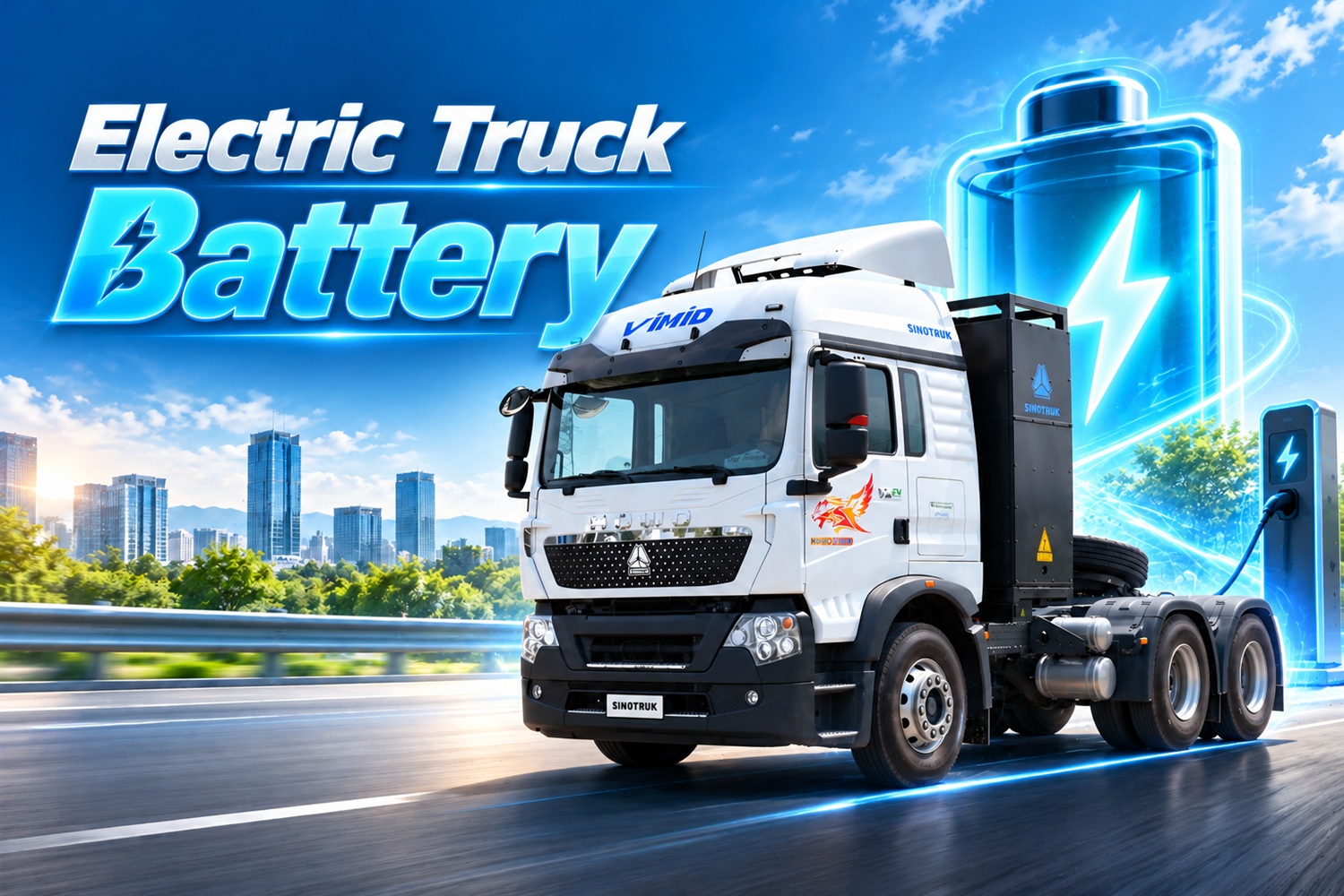
Many HOWO electric truck models manufactured by SINOTRUK currently use Lithium Iron Phosphate (LFP) battery technology. This battery chemistry is widely adopted in electric commercial vehicles due to its long cycle life, excellent thermal stability, and suitability for frequent charging and discharging.
CATL Batteries in HOWO Electric Trucks
CATL is one of the world’s leading lithium-ion battery manufacturers, supplying battery solutions for various electric vehicles, including electric trucks and semi-trucks.
In Vietnam, several HOWO electric semi-truck models are equipped with CATL LFP batteries. For example, the HOWO G7X EV Low-Roof introduced by VIMID features a 342 kWh CATL battery pack with a maximum charging power of 250 kW.
CATL’s LFP battery technology offers several notable advantages:
Long cycle life: Suitable for commercial vehicles that require frequent charging and discharging.
Excellent thermal stability: Helps reduce the risk of thermal runaway compared to certain other lithium-ion battery chemistries.
Fast-charging capability: Allows vehicles to replenish energy during breaks between transportation shifts, depending on the vehicle configuration.
Intelligent Battery Management System (BMS): Monitors temperature, voltage, and operating conditions to protect the battery pack.
Battery Capacities of Selected HOWO Electric Truck Models
SINOTRUK offers different battery capacities across its electric truck lineup to accommodate various transportation requirements and operating ranges.
| Vehicle Model | Reference Battery Capacity |
|---|---|
| HOWO G7X EV High-Roof | 342 kWh |
| HOWO G7X EV Low-Roof | 342 kWh |
| HOWO TX EV | Approximately 350–422 kWh, depending on the version |
Note: A larger battery capacity allows a vehicle to store more energy, but it does not necessarily mean a longer battery lifespan. Actual battery durability depends on cell technology, thermal management systems, charging and discharging intensity, and operating conditions.
Factors Affecting Electric Truck Battery Lifespan
The lifespan of an electric truck battery depends not only on manufacturing quality but also on charging habits and daily operating conditions.
Charging Frequency and Methods
Frequent charging and discharging increase the number of battery cycles. Additionally, keeping the battery at an extremely high or low state of charge for extended periods can accelerate degradation.
High-power fast charging may also increase battery temperature, particularly when the cooling system is not operating efficiently.
Ambient Temperature
High temperatures can accelerate battery capacity degradation, while low temperatures can affect energy delivery and charging performance.
Given Vietnam’s hot and humid climate, cooling and thermal management systems play an essential role in protecting electric truck batteries.
Payload and Operating Conditions
Trucks that frequently carry heavy loads, climb steep gradients, or operate in challenging traffic conditions consume more electricity.
As a result, they may accumulate more equivalent charging and discharging cycles over the same period, potentially affecting battery lifespan.
Battery Management System (BMS) Quality
The Battery Management System (BMS) monitors and controls battery operation by regulating voltage, temperature, current, and state of charge.
An effective BMS helps protect the battery against overcharging, over-discharging, and overheating while enabling early detection of abnormalities during operation.
Signs of Electric Truck Battery Degradation
After prolonged use, electric truck batteries may show signs of declining performance. Businesses should pay attention to the following indicators:
Reduced driving range: The truck travels fewer kilometers per charge, even when the payload and operating conditions are comparable to those in the past.
Abnormal charging behavior: Charging power decreases, the charging process is interrupted, or the battery management system displays warnings.
Declining battery capacity: The State of Health (SOH) value decreases significantly compared with its initial level.
Battery system warnings: The dashboard displays error messages related to temperature, voltage, or the high-voltage electrical system.
These symptoms do not always indicate battery degradation. Businesses should review BMS data and conduct technical diagnostics to identify the exact cause.
Effective Ways to Extend Electric Truck Battery Life
Proper battery usage not only helps prevent premature degradation but also enables businesses to maintain transportation efficiency and reduce long-term costs.
The following measures are particularly important:
1. Charge the battery correctly: When compatible with transportation schedules and manufacturer recommendations, maintaining a charge level of approximately 20–80% can be beneficial. Fully charging the battery is not necessary to avoid in every situation if the route requires it. Some LFP battery systems may also require periodic full charging to calibrate the BMS.
2. Use compatible charging stations: Choose charging equipment that meets the standards and power requirements recommended by the manufacturer. Avoid charging conditions that cause the battery to overheat.
3. Avoid excessive temperatures: Park in well-ventilated areas whenever possible, limit prolonged exposure to direct sunlight, and ensure that the battery cooling system operates properly.
4. Operate the vehicle efficiently: Avoid unnecessary rapid acceleration, hard braking, and overloading. Maintaining an appropriate speed helps conserve energy and reduces the equivalent number of charge-discharge cycles.
5. Inspect battery condition regularly: Monitor SOH, battery temperature, and BMS warnings according to the maintenance guidelines. Early detection of abnormalities helps reduce the risk of serious damage.
Frequently Asked Questions About Electric Truck Batteries
How Much Does It Cost to Replace an Electric Truck Battery?
For electric trucks in Vietnam, the cost of replacing an entire battery pack typically ranges from approximately VND 40–60 million to over VND 200 million per pack, depending on capacity, battery type, brand, and whether the replacement involves the entire pack or only individual modules or cells. For heavy-duty trucks with large battery packs, the actual cost can exceed VND 200 million when replacing the entire original equipment manufacturer (OEM) pack.
Should You Replace an Electric Truck Battery or Repair the Existing One?
Battery replacement is generally preferable when the truck must continue operating reliably for commercial purposes, covers high daily mileage, and has experienced widespread battery degradation. Repairing or refurbishing the battery may be appropriate when the damage is localized, the budget is limited, or the vehicle is approaching retirement.
For commercial fleets, reliability and vehicle downtime are often more important than the initial cost savings.
Does Fast Charging Degrade Electric Truck Batteries?
Fast charging can accelerate battery degradation if used frequently, particularly when the battery is hot, ambient temperatures are high, or charging takes place from a very low to a very high state of charge (SOC). However, fast charging performed correctly and without excessive use does not automatically damage the battery. The vehicle’s BMS reduces charging current when the battery overheats or reaches a high SOC.
If a truck operates one shift per day and has 6–8 hours of overnight downtime, use slower AC charging as the primary method and reserve DC fast charging for urgent situations. If the truck operates two shifts or runs long-distance routes, design the charging infrastructure to support fast charging within the 20–80% SOC range. Avoid repeatedly charging from nearly empty to full using DC fast charging, and prioritize charging stations with shade or adequate ventilation.
Conclusion
Electric truck batteries can last approximately 8–15 years under suitable operating conditions, particularly when equipped with LFP battery technology, which offers a high cycle life. However, actual service life still depends on battery quality, charging practices, operating conditions, and maintenance.
For HOWO electric trucks equipped with LFP battery technology, including certain versions featuring CATL batteries, businesses can select a battery capacity that matches their transportation routes and operational requirements. Combined with proper charging and operating practices, this approach can help preserve battery durability and optimize vehicle utilization over the long term.
Featured news


Related news

Amid the growing demand for transportation and road logistics, the resulting emissions, fuel consumption, and environmental pollution have become major challenges to achieving global sustainable development goals. Addressing this issue requires the creation of an environmentally friendly transportation system more urgently than ever. Toward this objective, Vietnam Machine Investment Development Joint Stock Company (VIMID – Stock Code: VVS) has pioneered research and implementation of green transport solutions – not only contributing to reducing emission and operating costs, but also supporting logistics enterprises in their journey toward green transformation.

On July 22, 2026, Vietnam Machine Investment Development Joint Stock Company (VIMID) and SINOTRUK officially signed a strategic cooperation agreement during the SINOTRUK New Energy Partners Conference, organized by Shandong Heavy Industry Group (SDHi)—SINOTRUK’s parent company and one of the world’s leading multinational industrial groups. The signing marks a new stage in the partnership between […]

Green trucks refer to transport vehicles designed to minimize environmental impact by optimizing fuel consumption, reducing emissions, or utilizing alternative energy sources. The concept of green trucks extends beyond electric vehicles. It also includes vehicles that comply with the latest emission standards (Euro V, Euro VI), fuel-efficient trucks, and vehicles powered by alternative fuels. In […]